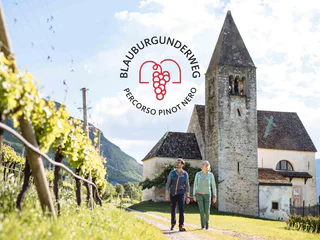
| Pour vos vacances à Eppan/Appiano sur la route du vin dans le Sud-Tyrol, sous le signe du bien-être et du divertissement, vous pouvez choisir parmi de nombreux hébergements qui répondent à vos souhaits. |
The parish church is situated in the old center of the village and is dedicated to the Virgin Mary. It was built in 1674 in order to have a second church because the Church San Pietro was often not accessible due to flooding of the Rio Nero. The architecture of the church is modest and simple. Inside, the baroque main altar with the life-size statue of Our Lady stands out. The two side altars are simple Baroque altars and dedicated to St. Anthony and St. Joseph.
Kaltern counts many different places that are especially reserved for children to play. The play area of S. Niccolò offers many different attractions and plays such as: sandboxes, slides, swings as well as climbing frames and a table tennis. Perfect for kids to have fun.
Servizio di contabilità, dichiarazioni dei redditi e paghe
Kaltern counts many different places that are especially reserved for children to play. The playground which is located in Kaltern’s village centre (towards the parking area Trutsch) hosts some very nice attractions for our little guests, such as: sandboxes, slides, swings, climbing frames and much more.
Harmony, creativity and functionality go beyond.
Fides means trust. Nothing is more valuable than that. It is the reason why we take our job very seriously. With dedication and passion, we focus on what we do best: creating spaces for our customers that make them feel comfortable and foster their productivity. Spaces where light, colour and materials with high technical functionality become a complete entity. Interior design at its best.
Extended structure consisting of three components dating from the Renaissance of the early 17th century. The starting point for its architectural development was a two-storey Gothic core on the Kirchplatz with the basement containing two large, vaulted rooms used for agricultural purposes. Several sandstone-framed windows and a portal in stone with lozenge-shaped ashlars and rosettes indicate the significant extension works during the Renaissance.
A large park is located directly to the east of the Steinkellerhaus.
During some excavations in the "Kahn" area in 1983, remains of an ancient Roman edifice were found. Those remains almost certainly belong to the "Endidae Mansio," which appears in the "Itinerarium Antonini." The large edifice with ground area of 737 m² featured a rectangular shape with a huge arcade and a central, partly roofed court. Several rooms were built around the court, which were probably relaxation rooms (cubicula) and a kitchen.
A rustic circular hiking trail along the Schwarzenbach/Rio Nero torrent to the waterfall offers a breathtaking natural spectacle offer. The "Katzenleiter" is a stone staircase consisting of 540 steps carved into the rock. The waterfall plunges into a 120-meter-deep gorge and offers a magnificent view of the entire south of South Tyrol all the way to Lake Kaltern. If you continue climbing the steps, you will reach the Brückenwirt inn in Montan/Montagna after a two-hour hike.
The Jewish business family Schwarz founded the steam-powered brewery in 1849. It was the largest in South Tyrol. In 1897, an electric power plant was added. The plant was equipped with the latest, state-of-the art turbine model, Pelton. Many parts oft he plant were made of steel casting which are still perfectly preserved today.
In 1924, the brewery was sold and transformed into a malt brewery. Pilsner, Münchner and Caramel malt beers were produced.
The electrical power station was in use from 1897 until the malt brewery closed down in 1986. The whole area then became the property of the Autonomous Province of Bozen. The regional Fire Brigade school was built on the site, but a few of the original buildings have been preserved. At Heinrich Erschbamer’s instigation and his untiring commitment, the electric power plant has been professionally restored and has been open to the public since 2014.
Indoor plants, plants for your balcony or garden: the gardeners are experts for all your concern.
Geographical publishing, Cartography and Advertising
Hiking maps, road maps, panoramic maps and maps of South Tyrol and Trentino.
Roner - the most awarded distillery in Italy. The family company was founded in 1946 by Gottfried Roner and is now managed by the third generation. The Roner distillery stands alongside the Williams product and excellent fruit distillates for high-quality grappa and exciting innovations such as gin and rum. Quality –
Taste - Tradition and Innovation have recently been awarded the "Fruit Spirit of the Year 2020" (ISW) for Caldiff Privat and numerous other gold medals in international tasting competitions. Enjoy the diversity of South Tyrol and immerse yourself in the fascination of the art of distillation! Learn more about the unique innovative pot style "Luisa", a milestone in the art of distillation.
Guided tours
Tour are held every Monday at 10.00 and Thursday at 14.30 only in German and Wednesday at 15.00 only in Italian, the cost per person is € 12.00. The tastings are reserved to adults (age +18). The guided tour is free up to 16 years of age. Reservations required: Tel. 0039 0471 864 010 – visite@roner.com
For groups it is possible to book a personalized tour and tasting also in English. For more information send an e-mail to visite@roner.com
Roner store and Bar in Termeno
In our shop in Termeno you can find the complete assortment of Roner products, some exclusive “gem”, Ritterhof estate wines and local specialties. In our bar area you can enjoy coffee, snacks and cocktails mixed with Roner products. The Store’s staff is on hand to advise you and make you discover the world of “Spirit”.
Timetable of our Store
Monday – Friday: 9:00 to 12:00 and 14:00 to 6:00 p.m. Saturdays: 8:00 to 12:00 From August to the end of October open all day Monday – Friday: 9:00 to 18:00 Saturdays: 8:00 to 17:00 In the months of September and October, our shop is open for you also Sunday from 09.30 to 13.00.
To the south of Bolzano, on porphyry rock, a vast castle arrangement, by the way, one oldest is in South Tirol. On account of her impressive situation, it is - as it is due to her beauty - also far away obviously. History: Castle Sigmundskron was called in the first historical mentions about 945 "Formicaria". In 1027 the German emperor gave the dukedom of Trento as well as the county to Bolzano to the bishop of Trento. In this manner the building went over in his possession and was used from now on as a seat of the Amtsmänner responsible for this territory and, moreover, still for high court meetings. An enlargement of the castle in 12. and 13. Therefore, Jhd. became necessary. Very pleasantly for the rulers of the area was the control of the navigation on Eisack and Etsch. The only entrance of Bolzano to Eppan could be closed up to the construction of the first bridge about 1200 easily. About 1473 the castle went over in the possession of Sigmund to the coin empires, princes of Tyrol. The lover of nice castles allowed to develop the arrangement immediately. As his most splendid construction the duke called this "castle Sigmundskron". However, soon afterwards Sigmund gets in financial difficulties. He must pledge his work, the castle slowly goes to ruin, because it is also not inhabited any more constantly. 1957: The next important event which takes place within these walls is the national rally against "Verwelschungsbestrebungen" (lot of Trento), i.e. against the disregard of the "Paris contract" about 1957. In 1976 an innkeeper's family raised for the first time the courage to renovate partially the castle to open the guest company in these romantic surroundings of course also at the same time. In 2006 The sacristan Mountain of museum of Firmian in the castle Sigmundskron/Firmian is opened. Architectural style: The castle is built mainly in the highly medieval style. The slender donjon in the untercastle shows Late-Gothic rebuildings. From the 13th century is the residential tower with round arch door as well as round arch windows. One recognises two gun turrets by the up to 5-m-thick curtain wall in the upper precastle, among the rest, moreover, you find a living - and economic building in the court (the place of the today's restaurant). Specific features: Highly - and untercastle are unambiguously separated by a rock formation, a natural barrier which one often does not find thus. Duke Sigmund made the castle by stonecutters decorate, it had to go nicest in his collection. The different dimensions of the loopholes also do not correspond to the norm of that time.
The fertile terrace between Auer/Ora, Neumarkt/Egna, and Montan/Montagna is an ancient cultural landscape. Castelfeder was the center of human existence in the south of South Tyrol for thousands of years. There are traces of settlements from the Stone and Bronze Ages. The remains of a castle complex, the legendary fertility chute and the walls of the Barbara Chapel bear witness to a mystical past. Also, Raetians, Romans, and other tribes who settled in the area around the hill retreated to the 400-meter-high hill in troubled times and left their traces.
After the fall of the Western Roman Empire, the Byzantine Empire had Castelfeder refortified as a bastion against the Germanic tribes shortly after the year 500. On this "acropolis," hundreds of people could find refuge together with their cattle and supplies. The last remains of the 500-meter-long ring wall of this largest fortress of the Adige Valley are the "Kuchelen," whose construction resembles the city wall of Constantinople.
Because of the Mediterranean vegetation, the area was called the "Arcadia of Tyrol" by romantic poets. The Castelfeder hill is important not only from an archaeological and historical point of view, but also from an ecological one. Thus, a zone with an area of about one hundred hectares was placed under landscape protection as a biotope years ago. Due to the Mediterranean climate, it is particularly mild on the hill as early as March. Today, Castelfeder is home to some animals that have become rare in Europe. The biotope's flora and fauna can be explored on the nature discovery trail.Meat is a precious food. To offer this in the highest quality is our passion. Expect a wide selection of fresh meats, sausages, ham and bacon specialities almost entirely from our own production in S. Pauls.
The fruit cooperative frubona Obstgenossenschaft Terlan originally arises from six cooperatives in the Bozen-Etsch Valley area. It has existed in its present form since 2010. 426 members cultivate a total of 1,154.55 ha of net area. In the shop you can buy apples.
Patronal feast: November 6th The late Romanesque rotunda was probably connected to a medieval pilgrim hospice. On the frescoes on the inside, at the feet of the sculputre "St. Leonhard with the chain", the coat of arms of the lords von Fuchs is recognizable. Around 1420 a new building of the church was built. The equipment came from the "Grabenkirche" of Bolzano.
Tower in Pianizza di Sotto
The medieval residential tower was owned by the lords Fuchs von Fuchsenberg in 1739.
Source: Parrish office Kaltern
The Capuchin monastery and its small church were built between 1617 and 1620. The church has a simple design in accordance with the style and regulations of the Capuchin Order: simple in terms of furnishings, bare walls, barrel vaults, and a side chapel on the south side. The high altar is dedicated to the Sacred Heart. The pulpit and the side altars are neo-Romanesque and date back to the 19th century. The altar of the side chapel contains a statue of the mother of God with Child from the middle of the 16th century, which is said to have miraculous powers. Between 1999 and 2003, the whole complex was carefully restored. In the little church, this also led to the renewal of the windows and the benches, which – in harmony with the surroundings – are now simple and linear. Thus, the light penetrates through seven beautiful glass panes that seem to communicate with the faithful through their symbolic meaning of colors and number.
The Parish church "Maria Himmelfahrt" (Mary´s ascension) by Terlan is a building from the High Gothic Period of the 14th Century. The altar room and the choir chairs are the oldest part of the building.
Catholic services: Sat. 7 pm (every 2nd and 4th saturday of the month) and Sun. 8.45 am (every 1st, 3rd and 5th Sunday of the month) in German and every Sunday 10.15 am in Italian.
Geier fruit and vegetables is your shop in Kaltern for freshness and quality. Our priorities are competence and reliability. At our shop you will find fresh vegetables, also organic ones and much more…
Founded in 1989, the Alarmstudio company has been successfully selling, installing and maintaining electronic security systems for private and commercial use for over 25 years.
Thanks to a network of qualified suppliers and partners, we are able to offer our customers tailor-made complete solutions. Qualified employees guarantee professional installation and efficient customer service.