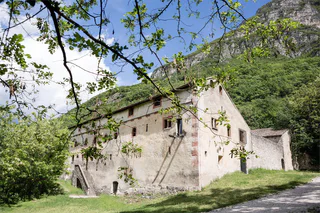
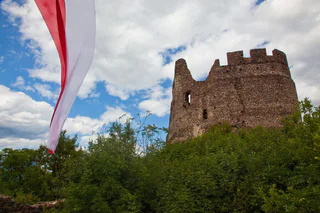
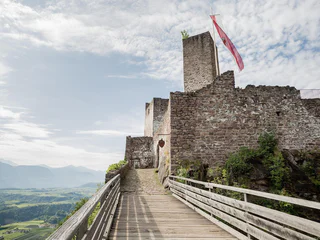
Neuhaus Castle Ruins (Maultasch) Neuhaus Castle was probably built in the early 13th century as a double castle: today only the walls remain. These were carefully restored, so that visitors can imagine what life was like there, in early times.
Obujte si turistické boty a prozkoumejte krajinu podél jihotyrolské vinařské stezky. Tyto tipy na výlety vás zavedou po klikatých cestách, přes malebné vinice a půvabné vesničky až na bezstarostná panoramatická místa. Od nenáročných procházek až po náročné túry - každý si zde najde doslova to své. Dokonalá kombinace požitku z přírody a kultury při vychutnávání místních vín a vřelé pohostinnosti charakterizuje Jihotyrolskou vinařskou stezku jako turistickou oblast pro znalce.
Neuhaus Castle Ruins (Maultasch) Neuhaus Castle was probably built in the early 13th century as a double castle: today only the walls remain. These were carefully restored, so that visitors can imagine what life was like there, in early times.
Along the geological path you will find a lot of signs and stations that shows the geology and the connected relations. The main attraction of the trail is the "Höllenbach" catastrophe of 1986. Following the path you will arrive on a big rock of tufa and the S. Nepomuk santuary. This rock last a violent mudslud and reminds the power of nature. The next sign reminds the mudslide of 1986. Just a short look to the panorama shows the different layers of rock from Montan to Weis and Schwarzhorn. Nearby you will find another rock. That's a Voltago conglomerate who resisted a mudslide 245 millions of years ago. After it there's the possibility to take a little break on a quiet island with 5 columns and a little bench with some small different rockets from the sourroundings. On the dam of the river a sign will explane you the different layers of the rock infront of you. The last sign indicate some fossils which where found in the river bed and with a bit of luck also you could find one.
Moderately difficult hike below the Mendel Ridge, mostly on forestry trails with beautiful viewpoints over Eppan, the entire Überetsch and the Bozen basin.
Appiano has a distinctive architectural potential: Medieval castles, palaces and manor houses, traditional farms and newer grand villas in gentle hilly terrain sorrounded by vineyards.
This challenging segment leads from Gfrill / Cauria (1,330 meters above sea-level) via the hamlet of Gschnon / Casignano and the Cisloner Alm and to Aldein (1,200 meters above sea-level). At the beginning, the route is uphill via the Gfrill Saddle until you reach Gschnon (option for rest-stop, food/drink, and overnight lodgings). From there, you will continue over the asphalt road uphill until you come to Mühlen / Molini (again: option for food/drink and overnight lodgings). After that, it's a rather steep path up to the Cisloner Alm. From here, you will proceed downhill until you reach the Aldein Bridge (known as the "Little European Bridge" when built back in the 1960s). This is a good spot to make a rest-stop (lodgings also available). You can then continue via Holen / Olmi until your come to Aldein / Aldino.
The tavern Bergjosl is located 600 meters above Terlan, but already belongs to the municipality of Mölten. The turnoff to the mountain restaurant is located halfway between Terlan and Mölten. The Mair family, owners of this Buschenschank, is supervising as well the only forest cemetery for animals in South Tyrol.
For used hikers this tour can start at the center of Terlan by walking along the Kirchgasse until reaching its end. Here you can find the last farm „Klaus in der Mühle" with its old mill. On the right starts the path to the weather cross (no. 3 A). You will reach the street to Mölten in front of the subway; take the way on the left and turn emediately right, in order to not pass the subway. From here take the left path after the second bend.
An other version of this way would be along the Weiler „Montigl" – „Grunerhof" and then through the scottish pine wood along rock faces to a panoramic view point. From here you can already see the "Buschenschank Bergjosl" and you reach it on a firstly slight descending path then go right.
The Castelfeder hill is an ancient cultural landscape with settlement remains dating back to the Stone Age and Bronze Age. The remains of the castle complex, the legendary “slide of fertility” and the Santa Barbara chapel walls are testament to its mystical past. The area is of particular importance not only from an archaeological and historical perspective but also from an ecological point of view as for years it has enjoyed the status of being a protected natural habitat (biotope).
From the village center, proceed to the sculpture garden where you can view various fascinating sculptures made of different materials. You can then continue through the splendid natural landscape until you come to the Niedere-Höfe Trail. You will pass by the Perkeo Restaurant and then through the village back to the starting-point. This is an easy stroll through the romantic natural surroundings and culture of Buchholz.
From Andrian walk through the gorge of river Gaido to the ruins of Festenstein - the trail is very steep and requires attention - continue to the hamlet of Gaido (Moarhof). a short distance along trail no. 8, continue along trail no. 6 to the viewpoint Burgstalleck and descend via the Sattelweg trail to the Bittnerhof farm and back to Andrian.
The hike offers some beautiful viewpoints: take some time to rest and enjoy the view: at the ruins of Castelforte (Festenstein), at Payer's Peak (Burgstalleck) and above Andriano at Schlosspichl.
This leisurely stroll follows a country road through the vineyards to Tramin. At the halfway mark, in the tiny hamlet of Rungg, there is a farmer's inn offering drinks and snacks where you can rest (closed Wednsedays). After a visit to Tramin, we follow the same road back to Kurtatsch.
On this segment, you will proceed first from Gfrill to the bogland lakes of the "Weiss" and the "Schwarz." From there, the route continues to the Horn-Alm, the highest point of the segment. Hikers can stop here for refreshments and then continue downhill via the Ziss Saddle – not far from there, you can admire the stunning "huckete Stoan," a free-standing erratic boulder made of porphyry the size of a house – until you come to Altrei.
At the bottom of the Gantkofel the Eppaner Castle triangle is located. On the art-historic walking tour you get an impression of the mediaeval South Tyrol. The walking tour to the castles takes you to the Castle Triangle. First you reach the Castle Hocheppan, which is one of the most important fortifications of SouthTyrol. After a visit as well as refreshment at the Castle tavern the hike continues to the ruin Boymont. A little bit underneath Castle Korb is located, which derived from the Roman époque and is now a hotel.
In 1494, the famous German artist Albrecht Dürer travelled for the first time to Italy. His final destination was Venice. Because of the flooded Adige valley, he had to bypass from the cloister St. Florian in Egna/Neumarkt to Buchholz/Pochi. During his stay in the Segonzano Castle, he created a few of his most important watercolors.
A Part of the path is accessible today.
Starting from the pilgrims hospice “Klösterle” in St. Florian, the hiking path number 8 leads to Laag/Laghetti. From here to Buchholz/ Pochi we pass the famous “roman” bridge. To Garbe and Laag and back to Klösterle, you have to leave the Dürerweg just before the village of Buchholz and follow trail no. 3.
This hike leads through the Trudner Horn Nature Park, a natural jewel with diverse animal and plant life.
The Pichl is the starting-point for the Gfrill Village Route. From here, you continue to Unterstein and then along the cableway trail until you come to the remains of an abandoned cableway. From here, the Berger Trail will take you to the Old Gfrill Road. Continue along it until your get back to your starting-point at the Pichl.
Walking time: 60 - 90 minutes
Walk along the historic town center „Betlehem“, through the Gewürztraminer vineyards above Tramin-Termeno. Enjoy the Mediterranean culture, the landscape and a unique view on Tramin-Termeno and the environment.
When you take this extra segment, you will begin from Gfrill, which is located at approx. 1,300 meters above sea-level, and continue to Buchholz at 560 meters above sea-level. At first, you'll have a pleasant, relaxing stroll downhill until you come to Unterstein. You can then continue along the old aerial lift trail until you reach the vestiges of an old cableway. The trail then goes downhill until you come to the brook where the Truden Faultline is especially noticeable. This boundary is distinctly visible not only on the basis of the different geological strata (dolomites and porphyry), but also due to the abrupt change in vegetation. You can then continue to the small village of Buchholz.
On a dizzyingly high outcrop of dolomite rise the medieval ruins of Salorno’s castle - Haderburg. It was built in the first half of the thirteenth century and is one of the most important monuments in South Tyrol. The castle with its winery is open to the public from Easter until All Saints. Each year Salorno-Haderburg Castle hosts musical, literary and folk events.
From the small village of Buchholz, you will then continue on to Gfrill. Right after Buchholz, the Truden Faultline becomes especially noticeable. This boundary is visible not only on the basis of the different geological strata (dolomites and porphyry), but also due to the change in vegetation. The trail is steadily uphill until you come to the ruins of the walls of an old cableway. You continue along the old cableway trail, steadily uphill, until arriving in Gfrill, an alpine village surrounded by plenty of natural beauty.
This hiking path goes through fabulous beech groves and pictorial forests.
Hiking tour from the center of St. Michael | Eppan to the Montiggl lakes.
TIP: Go for a swim in one of the lakes and return to the starting point with the lake & hiking bus which runs from mid-June to early September.
The ropeway path leads from Gfrill/Cauria to the historic ruins of the ropeway station for material and wood transport.
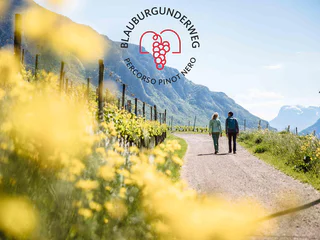
The Pinot Noir walkway leads through the Pinot Nor growing area along the Trudner Horn/Monte Corno Nature Park and the characteristic villages of Auer/Ora, Montan/Montagna and Neumarkt/Egna. The Pinot Noir growing area in Montan and Mazon/Mazzon is one of the most famous in Italy. Furthermore you walk through several monuments and historical places. The walkway is family-friendly and not dangerous.
Itinerary: A phenomenon that attracts visitors from all over South Tyrol, happens in Spring Valley between the two Laghi di Monticolo/Montiggl Lakes and Lago di Caldaro/Caldaro Lake: Yellow primrose, white daffodils, violet liverleaf, blue crocuses and primroses are stretching towards the sky - a colorful natural patchwork pleases everyone after the harsh winter days. Right in the middle there is as well the peaceful little Angel stream meandering southward. Best time to enjoy it is between mid February to late March.
From the car park the walk goes across the narrow strip of asphalt (not the main street) right down to the hamlet Monticolo/Montiggl. In the village it turns right in front of the church and follow the small asphalt street for 20 minutes through orchards and then through the forest to a crossroads. After 50 meters the Spring Valley is at the left. Going right the walk ends at Lago di Caldaro/Kaltern Lake passing through the lower part of the Spring Valley. However, on the left the walk goes up through the lovely valley following the signs to the asphalt street.
On this segment, you will proceed from the famed Pinot Noir village of Montan uphill to Aldein – from 500 meters up to 1,200 meters above sea-level. At the beginning of the segment, you will take the "Wine Forest Water" Trail and pass by the Enn Castle and the Elsenhof farmstead which belongs to it. You will then proceed along the old tracks and through the spruce forests (common here on the southwest flank of the Cislon) and farther to the Aldein Bridge (known as the "Little European Bridge" when first built in the 1960s). This is a good opportunity for hikers to make a rest-stop and/or get some refreshments. You will then proceed to the hamlet of Holen and on to Aldein.
Start off by walking up Kirchgasse to the beginning of the Margarethe Promenade. Then take the old, mostly cobble-paved Montigler Road (no. 9). After about 30 minutes on the incline you reach a cross-roads with the path coming from the Neuhaus ruins on the right and leading to Montigl. Continue on the old Montigler Road until you reach the new Montigler Road. Continue eastward on the new Montigler Road for approx. 20 minutes until you reach the "Moarhof" Farm. It is the last farm on this high plateau (not open to the public). In order to get back down to the valley, the moderately steep and little used road to Terlan can be utilized. Where it meets the road to Mölten it is preferable to cross it, go up for about 40 m and take path no. 3 to get back down to the village. After several hairpin bends your path meets the road to Mölten, coming out of a tunnel again. Follow it for approx. 50 m. Then there is an opening in the guard rail where the trail no. 3 A continues. After about 20 m we suggest you take a quick detour to the left to the "Wetterkreuz" (weather cross). This beautiful panoramic viewpoint grants a look at the ruins of the St. Peter Miner's Chapel that was built in the 14th century and on the opposite mountain slope you can still see the entrances to some galleries from the 15th century, when mining had its heyday in this region. The path then continues a little steeply down to the farmhouse "Klaus in der Mühl" and eventually feeds into the Kirchgasse which leads you back to the starting point.